

Dental health is essential to our overall well-being, and maintaining a healthy, attractive smile is something that many people value. However, there are cases in which the damage to the teeth is such that, instead of a simple restoration, more advanced solutions are required. Dental implants are one of the most common options for replacing missing teeth, but what happens when there is not enough bone to place an implant? This is where bone-free dental implants come in, an innovative solution that can restore your smile’s functionality and beauty, even if you do not have enough bone in your jaw. In this article, as experts in dental implants in Marbella, we tell you everything you need to know about bone-free dental implants.
What Are Bone-Free Dental Implants?
Conventional dental implants require an adequate amount of bone in the jaw to ensure that the implant is securely fixed. However, some people do not have enough bone due to bone loss caused by tooth extraction, periodontal disease, or the passage of time. In these cases, the term bone-free dental implants refers to solutions for patients whose bone volume is insufficient to support a traditional implant.
Why Do We Lose Bone in the Jaw and Mandible?
Bone loss in the maxilla and mandible is a common problem in many people and can occur for a variety of reasons. Understanding why bone is lost in these areas is essential to understanding how bone-free dental implants work. The main causes of bone loss include:
- Tooth Loss. When a tooth is lost and not replaced with a dental implant or some other type of prosthesis, the bone surrounding it begins to deteriorate. This is because the maxillary or mandibular bone needs pressure stimuli (produced by chewing and biting) to stay strong and healthy. The lack of a tooth to stimulate the bone causes gradual bone resorption.
- Periodontal Diseases. Periodontitis is an advanced gum disease that can destroy both the soft tissue and the bone that supports the teeth. This disease causes significant bone loss in the jaw and maxilla, often making it impossible to place a traditional dental implant without prior bone grafting.
- Tooth extractions. After a tooth extraction, it is common for the bone to begin to resorb naturally. This process is part of healing, but in some people it can be more pronounced, resulting in considerable bone loss, especially if the tooth has been extracted for a long period of time.
- Systemic Diseases. Certain medical conditions, such as osteoporosis, can affect bone density throughout the body, including the jaw and maxilla. This, as experts in dental implants in Madrid and other cities can attest, can make the bone more susceptible to loss, making it difficult to place dental implants.
- Ural ageing. Over time, bone density tends to decrease, which can result in gradual bone loss in the jaw and maxilla. The lack of constant stimulation (such as that provided by chewing) can accelerate this process.
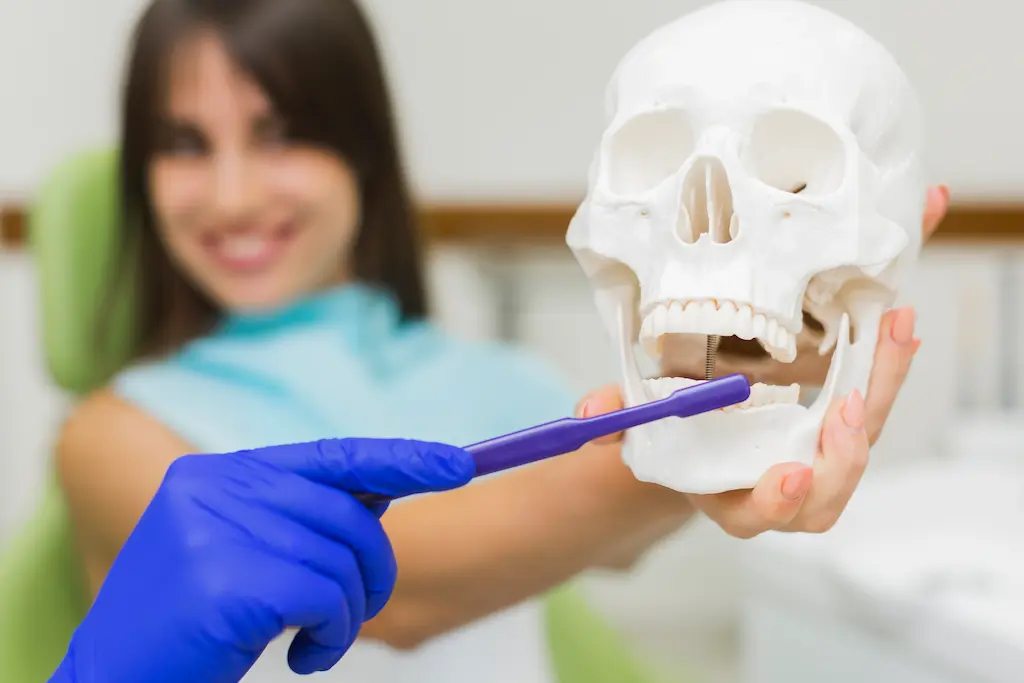
Bone regeneration techniques for dental implants
Bone graft
It consists of adding bone material to areas where bone is missing in order to place implants. The graft can come from the patient themselves, from a donor, from an animal source, or be synthetic. Over time, this material integrates with the natural bone and creates a stable base for the implant.
Guided bone regeneration (GBR)
It uses special membranes that protect the graft and prevent soft tissue from invading it. This allows the bone to regenerate properly in small or moderate defects, maintaining the space necessary to form quality bone.
Maxillary sinus elevation or grafting (sinus lift)
This procedure is performed when there is insufficient bone height in the upper jaw. It involves lifting the maxillary sinus membrane and placing graft material underneath it. This creates additional bone height so that implants can be placed, either during the same surgery or after a healing period.
Bone expansion or split crest
Suitable when the bone is too narrow. The surgeon divides and separates the bone ridge to widen it and create space for the implant. This often allows the implant to be placed during the same surgical procedure.
Osteogenic distraction
Advanced technique for increasing bone height. A small device gradually separates two bone fragments, stimulating the formation of new bone between them. It is used in cases of significant bone loss where other techniques are insufficient.
Benefits of Bone-Free Dental Implants
Bone-free dental implants offer a number of advantages for those with bone loss. Among the most notable benefits are:
- Quick recovery. Some options, such as zygomatic implants or the All-on-4 technique, offer faster recovery times compared to traditional bone graft treatments.
- Fewer invasive procedures. With bone-free dental implants, patients can avoid bone grafts and other more invasive procedures, reducing the risk of complications and improving the overall treatment experience.
- Aesthetic and functional results. These options provide an aesthetic solution, restoring patients’ natural, functional smiles and allowing them to once again enjoy comfortable chewing and greater confidence.
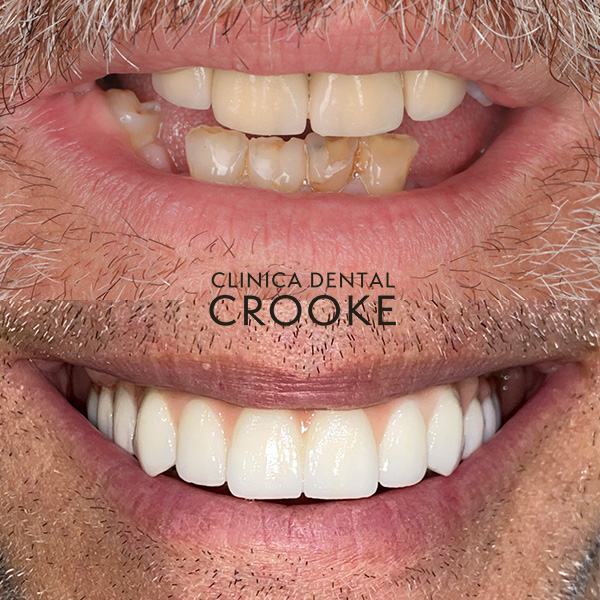
Case of dental implant without bone performed at Crooke Dental Clinic
Most commonly used types of bone-free dental implants
Fortunately, there are now several options available that allow patients with bone loss to restore the functionality and aesthetics of their smile without the need for invasive procedures such as bone grafts. Discover all the dental implant options available at a dental clinic in Malaga such as Crooke Dental Clinic. Here are some of the most common alternatives:
Zygomatic Implants
Zygomatic implants are a revolutionary option for patients who do not have sufficient bone in the back of the upper jaw. Unlike traditional implants, which are placed in the jawbone, zygomatic implants are fixed to the cheekbone (zygomatic bone). This provides a quick and effective solution without the need for bone grafts, as the zygomatic bone is usually stronger and denser.
This type of implant is ideal for patients who have experienced significant bone loss in the upper jaw and do not wish to undergo complex and lengthy bone grafting treatments.
Short Implants
Short implants are a less invasive solution and an effective alternative when there is insufficient bone available for traditional implants. These implants are smaller and shorter than conventional implants, so they can be placed in areas with low bone density. As they do not require large amounts of bone, they are ideal for patients with moderate bone loss in the posterior region of the jaw.
Although not suitable for all cases, short implants offer an excellent option for patients who wish to avoid more complex procedures, such as bone grafts.
All-on-4 Technique Implants
All-on-4 is an innovative approach that allows a fixed prosthesis to be placed on the same day using only four implants. In our experience at our dental clinic in Madrid, this technique is very effective for patients with significant bone loss, as it makes use of the available bone in the front of the jaw, avoiding the need for bone grafts or additional procedures. With All-on-4 implants, a complete restoration can be placed that improves both aesthetics and functionality.
It is important to note that this option requires a thorough assessment by the dentist, who will determine whether the patient is suitable for this treatment.
Bone Expanders (Bone Distraction)
Although not an immediate option, bone expanders or bone distraction can be an effective solution, which we use to increase the amount of bone in an area where there is a deficiency. This process involves the use of a device that stimulates bone regeneration through a series of controlled movements. Over time, new bone forms, allowing a dental implant to be placed safely.
This treatment is slower, but for patients with extreme bone insufficiency, it may be a viable option.
Regain Your Smile with Bone-Free Dental Implants
Bone-free dental implants represent a viable and effective solution for those who have lost a significant amount of bone in the jaw, offering various options that allow for the restoration of the functionality and aesthetics of the smile. Whether through zygomatic implants, short implants, the All-on-4 technique, or bone expanders, advances in dental implantology offer real hope for those who thought they could not benefit from a dental implant.
*** Translated with www.DeepL.com/Translator (free version) ***
If you are considering a dental implant and are concerned about bone loss, we invite you to consult with an implantology specialist to explore the options that best suit your needs. Regain your smile and improve your quality of life with bone-free dental implants at Crooke Dental Clinic!