

Yes, a broken root canal tooth can be repaired in most cases, provided that the root of the tooth and the supporting bone are in good condition.
The type of treatment will depend on the extent of the fracture, the amount of tooth structure remaining, and whether or not there is infection.
Thanks to advances in restorative dentistry and adhesive materials, it is possible to restore both the chewing function and the aesthetics of the treated tooth.
What does it mean to have a broken tooth after a root canal?
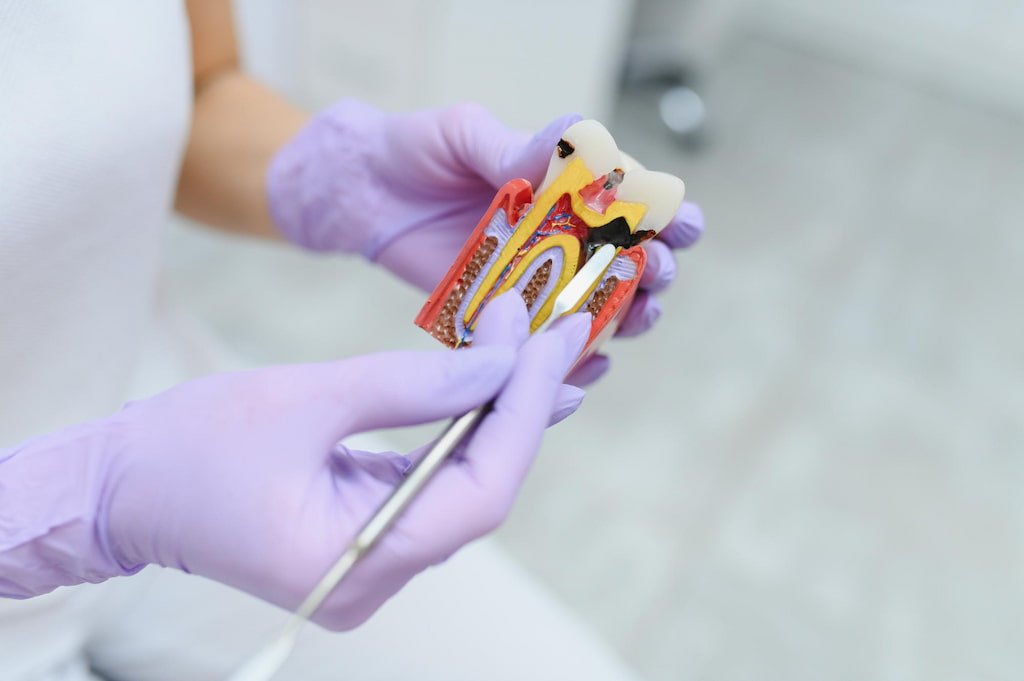
When a tooth has undergone root canal treatment, the dental pulp is removed, reducing its natural hydration.
This causes the tooth to become more fragile and susceptible to fractures. If a tooth breaks after root canal treatment, it is usually due to one of the following reasons:
- No crown or inlay was placed after treatment.
- There was a very strong bite or masticatory trauma.
- The previous restoration material wore away or leaked.
- There is untreated bruxism (teeth grinding).
A crack in a root canal-treated tooth does not always mean losing it. With the right diagnosis, most cases can be successfully resolved.
Types of fractures in a broken root canal-treated tooth
Not all fractures are the same, and their severity will determine the type of solution.
Below are the most common types:
- Superficial fracture (enamel or cusp) This is the mildest type of fracture. It generally affects a small part of the tooth without compromising the root or the root canal filling. It can be easily repaired with resin or composite.
- Medial fracture (dental crown) Affects a larger portion, sometimes reaching the base of the crown. In these cases, reconstruction with a post and crown is required to reinforce the structure and protect the root.
- Deep fracture (vertical or root fracture) This is the most serious type of fracture, as it goes through the root of the tooth. When this occurs, the tooth cannot be saved and it is recommended that it be extracted and replaced with a dental implant or bridge.
Identifying the type of fracture using X-ray or 3D tomography is essential before deciding on treatment.

Treatments to repair a root canalised tooth
The choice of treatment depends on the extent of the damage and the condition of the root:
- Composite resin reconstruction: Ideal for small fractures. Allows the shape and function of the tooth to be restored in a single appointment.
- Placement of a post and crown: When the remaining tooth structure is minimal, a post is placed inside the root canal and a porcelain or zirconium crown is placed over the entire tooth.
- Inlays or ceramic veneers: These are an aesthetic, durable and less invasive option for partial restorations.
- Re-root canal: If the fracture caused leakage or infection in the root, it may be necessary to repeat the root canal treatment before reconstruction.
- Dental implant: In cases where the tooth is not viable, an implant is the best functional and aesthetic alternative in the long term.
The dentist will determine the ideal option after a clinical and radiographic assessment.
When can a broken tooth not be repaired with root canal treatment?
Although many teeth treated with root canal therapy can be saved, there are cases where the fracture is so severe that repair is not feasible.
This occurs when:
- The fracture extends to the root or runs lengthwise through the tooth.
- There is chronic infection or bone resorption.
- The tooth exhibits advanced mobility or significant loss of bone support.
- The remaining structure does not allow for the placement of a stable crown.
In these situations, extraction and placement of a dental implant is the most predictable treatment for preserving chewing function and bone health.
Does it hurt to rebuild a tooth with root canal treatment?
No. The treated tooth no longer has a nerve, so the procedure is usually painless. In some cases, local anaesthetic may be used for comfort.
How long does reconstruction take?
It depends on the case. A resin restoration can be done in a single appointment, while a crown or inlay may require two or three visits.
Conclusion
In short, repairing a broken root-canal tooth is key to preserving the tooth and avoiding future complications.
This procedure strengthens the tooth from the inside, restoring its shape and giving it back the strength it needs to withstand daily chewing.
If you are looking for professional, long-lasting and aesthetic treatment, at Crooke Dental Clinic you will find specialists in endodontics and restorative dentistry who combine advanced technology with a conservative approach.