

Dental implants have become the safest and most comfortable treatment for solving tooth loss problems. Once in place, the implant fuses with the jawbone, providing a strong hold against external forces such as chewing or cutting food.
Before starting treatment with dental implants, the implantologist must study each patient’s case individually to determine the appropriate technique prior to surgery. Sometimes patients do not have the necessary bone base to correctly place the implant, so in these situations a sinus lift must be performed.
What are the techniques for breast lift surgery?
Sinus lift techniques allow implants to be placed in the upper jaw in posterior areas in patients with very low bone height. The different sinus lift techniques allow the height of the jaw to be increased vertically, filling the necessary part of the maxillary sinus with artificial bone in order to accommodate the dental implants appropriate for each case.
The maxillary sinuses are two cavities located in the upper jaw. They participate in breathing and protect the respiratory tract from infections.
When should breast lift techniques be used?
These techniques have opened up the possibility of placing implants and, therefore, fitting a fixed prosthesis in patients who have lost their teeth for a long time and who have significant bone resorption. To determine whether a sinus lift is necessary and to define the most appropriate technique, the patient must undergo a three-dimensional radiographic study (CBCT or CT scan). In this diagnostic test, we will evaluate both the density and volume of the patient’s bone. This allows us to plan the surgery correctly.
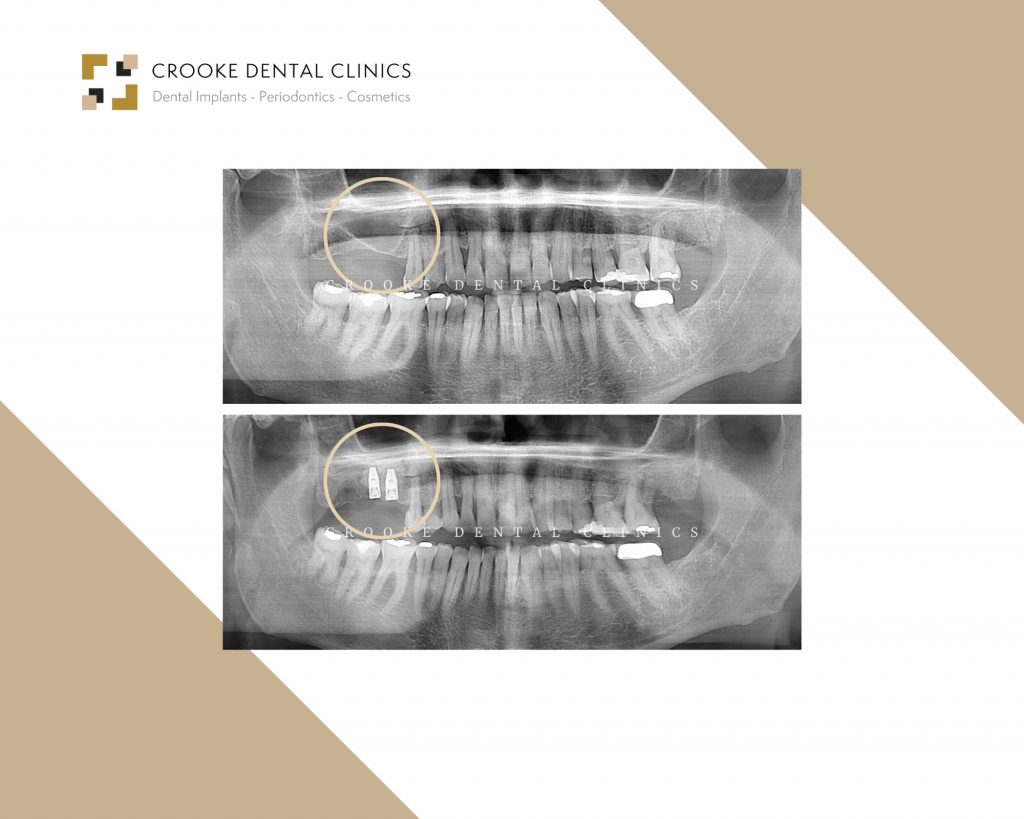
In the first quadrant, we can see patients with severe bone loss who underwent surgical sinus elevation. For this reason, we waited six months for the bone to heal and then placed two implants.
Different breast lift techniques
A breast lift is a surgical procedure that requires skill and experience.experience. It is recommended that it always be performed by a professional who is an expert in oral surgery, who will have the necessary knowledge to ensure the treatment is successful.
There are two types of breast lift:
Atraumatic breast lift:
It is performed on patients with at least 4 mm of bone. It is performed on the same day as the implant placement. Taking advantage of the drilling phase, instruments are inserted through the area being prepared for implant placement. instruments called osteotomes, which will help us lift the sinus membrane to impact the bone we are going to graft. The amount of bone will depend on each patient, but it must always be sufficient for the implant to be completely covered by bone and stable.
Surgical breast lift:
This technique is more laborious than the previous one. It is performed on patients who do not have the 4 mm of bone necessary to perform an atraumatic elevation. It is performed through the lateral wall of the sinus where, after detaching the gum from the bone, a window is opened with a rotary instrument. It is a very meticulous surgery but, thanks to it, implants can be placed in areas with little residual bone height, where it would otherwise be impossible.
Double surgical sinus lift for the placement of fixed posterior teeth.
The implants will be placed in a second surgical phase, as it is necessary to wait until the bone has sufficient hardness and consistency (around 6 months) for them to remain stable, although in some cases they can be placed simultaneously.
What precautions should we take after a breast lift?
Postoperative care following atraumatic breast lift surgery.
The postoperative period for this technique is straightforward. The prescribed medication must be taken as directed. Recommended by the surgeon to prevent inflammation and relieve any mild discomfort that may occur. It is recommended to apply cold to the area a few hours after the operation and to follow a soft diet for the following weeks, but above all, chew on the opposite side to the one that has been operated on.
Postoperative care following surgical breast lift.
In this breast lift technique, the post-operative period also involves medication to relieve any discomfort and inflammation that may occur.
It should be:
- Apply cold compresses during the first few hours after the procedure.
- Follow a soft diet for several weeks (it is essential to avoid hard or crunchy foods that could damage the area).
- Brush the area with a soft or surgical brush.
- Control sneezing and suction, and do not rinse too vigorously.
- Avoid pressure changes for a few weeks after the procedure; do not dive, climb, or fly.
Not sure if you need a maxillary sinus lift?
If you are missing a tooth, remember that the sooner you replace it, the better. the simpler the treatment will be.
Request your first visit free of charge and with no obligation