
What tests do I need before getting dental implants?
Before placing an implant, the team needs to know about your general health, the condition of your mouth and the amount and quality of available bone. That preliminary study is what allows the surgery to be planned safely. Not everyone needs the same tests: each one answers a specific question about your case.
Why are tests needed before implants?
An implant is placed inside the bone and has to bear chewing forces for years. Planning without information would mean operating blind: the preliminary tests make it possible to choose the position, size and number of implants, foresee whether bone regeneration is needed and reduce risks during surgery.
The first visit: your history and your mouth
The study starts before any machine. The team goes over your medical history with you: illnesses, medicines you take, allergies, previous operations and habits such as smoking. Certain medicines and conditions do not rule out treatment, but they change how it is planned.
Then your mouth is examined: the condition of your gums, your remaining teeth, your bite and your hygiene. Untreated gum disease, for example, is usually addressed before implants are placed.
Imaging tests: what each one provides
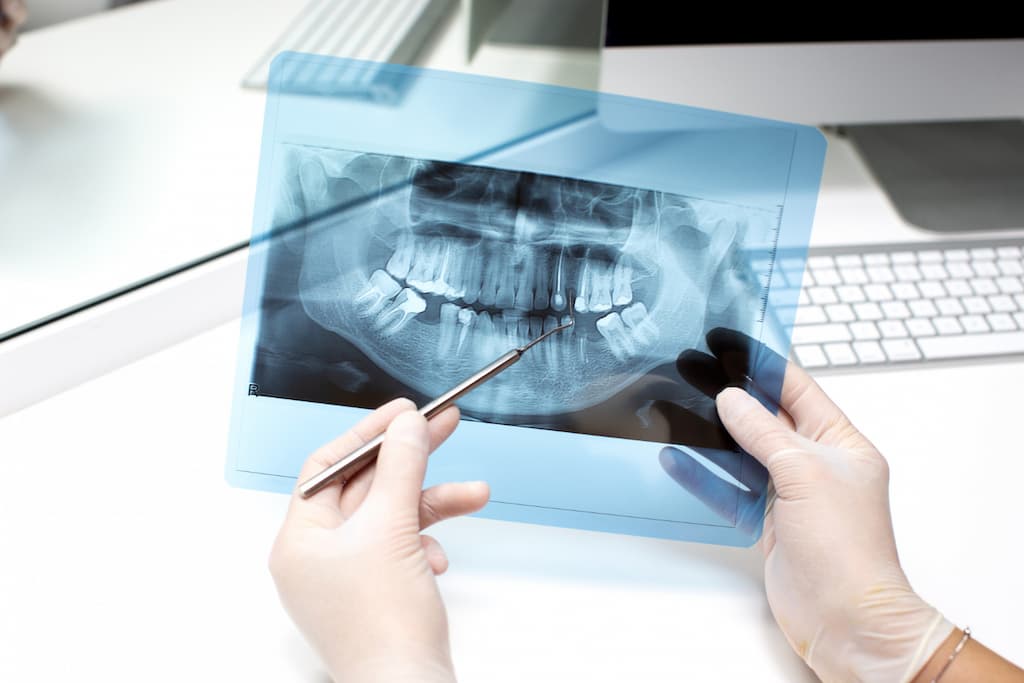
The panoramic X-ray offers an overview of the jaws, teeth and nearby structures. It is the initial map.
The dental CT scan (also called CBCT or 3D scan) shows the bone in three dimensions: it makes it possible to measure its height and width and to locate structures such as the dental nerve or the maxillary sinuses precisely. With that information the team decides whether the bone is sufficient, whether a graft is advisable or whether a technique for low-bone cases is a better fit. The CT scan is prescribed when the case requires it; it is not an automatic test for everyone.
Small detail X-rays can complete the study of a specific area.
Models, records and the treatment plan
With the scan or moulds of your mouth, photographs and bite records, the team designs the plan: how many teeth need replacing, what type of prosthesis is planned, where each implant will go and in which phases it will be done. That plan is also the basis for the quote and the treatment schedule.
Blood tests and other tests: when they are requested
They are not an identical routine for everyone. They are requested according to your medical history, for example when there is diabetes, anticoagulant treatment or other situations that should be known before surgery. If your doctor has recently run tests for you, mention it: sometimes they can be used.
What each test decides
- History and examination: whether you are a candidate for implants and what should be controlled first.
- Panoramic X-ray: the general map of your mouth and jaws.
- 3D CT scan: bone volume and the position of nerves and sinuses; it decides whether regeneration is needed and how the implants will be placed.
- Models and records: the design of the future prosthesis and the position of the implants.
- Blood tests (when applicable): the safety of surgery according to your general health.
What you can bring to the first visit
- The list of medicines you take, with their doses.
- Relevant medical reports and previous X-rays, even if they are old: they provide context, and the team will assess whether they need updating.
- Your questions in writing, so you do not forget them during the consultation.
Other frequent questions
Will I definitely have a CT scan? No. It is prescribed when planning requires it. In simple cases other images may be enough; in full-mouth rehabilitations or low-bone cases it is usually necessary.
Are X-rays I had taken years ago useful? They provide useful information about how your mouth has evolved, but if they are old or do not show what the team needs to measure, they will have to be repeated. Bring them anyway.
How long does the study take? It depends on the case. Some tests are done in the first visit itself and others are scheduled separately. Ask how many visits you will need before having the complete plan.
The study is the first step of the plan
At Crooke Dental Clinic, the preliminary assessment is the basis of any implant treatment: the options, the phases and the limits of each one come from it.
If you are considering implants, you can start by learning how we approach a full-mouth rehabilitation and preparing your questions for the first consultation.
General information for patients. This article does not replace an examination or your dentist’s instructions.